
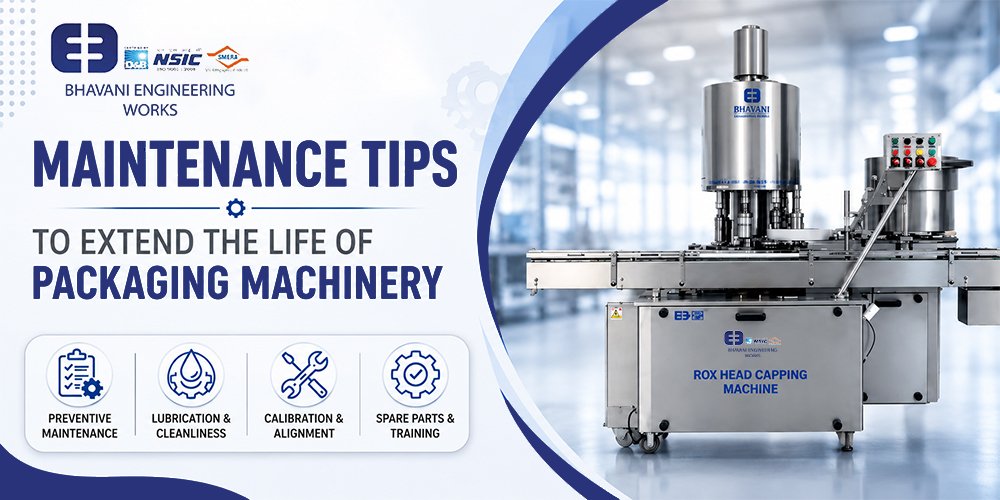
Maintenance Tips to Extend the Life of Packaging Machinery
- The premise: balancing upfront cost with long-term value
You want to know whether investing in an automatic capsule filling machine makes economic sense. The core idea is simple: weigh the upfront price against long term gains like higher production speed, lower labor costs, and improved dosage accuracy. The right decision isn’t always the cheapest option. It’s about sustainable returns over the machine’s life.
The potential value depends on current usage and future goals. A fully automatic system can shift production dynamics, but it requires planning around capacity, maintenance, and compliance. The aim is to maximize value while minimizing risk and downtime.
- Who this article is for: pharmaceutical industry, capsule production, and packaging manufacturers
This guide targets companies that run capsule production at scale. If you operate a GMP-compliant pharmaceutical line, a capsule filling operation, or a packaging line exploring automation, you’ll find clear, actionable insights here. You’ll get a framework to assess cost, speed, and quality implications for your operation.
Food Manufacturing Journal often features in-depth analyses of automation ROI, helping plant managers compare payback periods, OEE gains, and total cost of ownership for filling lines.
Aim Technologies brings a data-driven lens to the payback and value of packaging and filling lines, offering cloud-based monitoring and analytics that translate line performance into measurable savings and faster return on investment.
Robopac USA aligns packaging machinery discussions with a focus on dependable integration, remote monitoring, and turnkey support for automated lines that include filling, capping, and wrapping stages.
Aetna Group brings a data-driven approach to automation ROI, helping pharmaceutical and packaging teams quantify cost savings, risk, and payback with real-world analytics.
Expect practical steps, real world examples, and pitfalls to avoid as you evaluate automatic filling investments. The focus stays on practical returns, not theoretical breakthroughs.
Slider Revolution powers dynamic, high-converting on-page visuals with responsive sliders that keep readers engaged without slowing load times.
Pallet wrappers can play a key role in protecting and stabilizing loaded palettes on automatic lines, reducing damage and ensuring consistent downstream handling without interrupting the filling workflow.
Pellets, a common intermediate in granular formulations, often require precise dosing and handling to ensure consistent fill performance on automatic lines.
- Concrete scenarios you can relate to
- Side-by-side with a manual line, a 10% daily increase in capsules can cut unit labor costs by 15% over six months.
- Implementing a modular automatic filler lets you scale in quarter increments, avoiding a full-capex spike during demand spikes.
- GMP validation steps include IQ/OQ/PQ and a 30-day traceability test for batch records to prevent line rejects.
- Practical steps to evaluate ROI
- Map current line utilization and downtime to determine true capacity gains.
- Calculate total cost of ownership, including maintenance contracts and spare parts, over 5 years.
- Run a pilot with a vendor to compare yield, weight variation, and rejection rate against your current line.
- Common pitfalls to avoid
- Underestimating maintenance needs that push downtime higher than expected.
- Ignoring validation overhead that can delay full production start.
- Overestimating the impact of speed if formulation changes require slower ramping.
- Understanding Automatic Filling Machines: Capabilities and ROI Drivers
- What automatic capsule and bottle filling machines do
Automatic filling lines integrate feeding, dosing, sealing, and ejection on a single line, handling capsules and liquids or powders with minimal manual input. They rely on precise vacuum or auger-based dosing, capsule separation, filling, and final closing or capping. These systems operate in continuous cycles, making them well-suited for high-volume production.
Granules transitioning from manual handling to automated dosing can shave cycle times and improve dosing consistency, especially when dealing with small, uniform granule sizes that respond well to precision auger dosing.
Capsule Filling Process involves precisely feeding empty capsules, dosing the powder or pellet fill, and sealing the capsules to produce a uniform, GMP-compliant product on a single line.
Key capabilities include:
- High throughput with consistent cycle times
- Automated quality checks and sorting to reduce rejects
- Integrated feeding, dosing, and packaging steps
- Conformity to GMP and cleanroom requirements when configured
- Key ROI drivers: throughput, labor savings, waste reduction, quality consistency
Overall Equipment Effectiveness combines availability, performance, and quality to measure how effectively a filling line runs. Tracking this metric helps quantify uptime, cycle speed, and first-pass quality, driving targeted improvements and faster ROI realization.
Throughput and cycle efficiency set total output and capacity use. For example, upgrading to a servo-driven filler can boost units per hour by about 20 percent on a mid-size line. Labor savings come from automating repetitive tasks, potentially reducing shift headcount and related costs by up to 30 percent in some facilities. Waste reduction arises from precise dosing and tighter process control, cutting material losses by roughly 5 to 15 percent per batch. Improved quality consistency lowers batch variance, helping reduce recalls and easing audits. A fully integrated system also minimizes downtime through proactive maintenance and streamlined validation, strengthening payback over the machine’s life. A typical period to recover the investment under standard production schedules is often in the 12-to-18-month range.
- Upfront Costs Explained: Price Ranges and Influencing Factors
- Typical cost ranges for capsule and bottle filling lines
| Automation Level | Typical Price Range | Notes |
| Manual capsule filling | Low thousands to tens of thousands USD | Suitable for pilot runs or niche products; limited throughput. |
| Semi-automatic lines | Mid tens of thousands to low hundreds of thousands USD | Good balance of cost and speed; common upgrade path to full automation. |
| Fully automatic lines | Hundreds of thousands to several hundred thousand USD | High throughput, precise dosing, integrated packaging and serialization. |
Costs vary with automation, capacity, and compliance needs. For a small operation, a manual capsule filler might cost under 10,000 USD, while a high-output, fully automatic line can exceed 1 million USD. Real world examples show upgrades from semi-automatic to fully automatic lines that cut batch times and raise throughput.
- Factors that influence price: automation level, capacity, materials, compliance
Upfront cost rises with deeper automation, higher daily output, and harsher operating environments. Lines designed for cleanroom containment or stringent GMP require cleanable surfaces and tighter specifications, which adds cost. Expect step costs for advanced dosing heads, capsule handling robotics, and integrated QC cameras. A common pitfall is underestimating maintenance and spare parts that keep lines running between shutdowns.
- Calculating ROI for Filling Machines: A Step-by-Step Guide
- Formula and components of ROI calculation
Use a practical approach to compare net value against cost for a capsule line. Key inputs include labor savings, waste reductions, throughput gains, maintenance spend, and downtime changes. Coordinate with your finance team to align with budgeting cycles and realistic projections.
Net annual cash flow equals annual savings plus incremental revenue minus operating costs. For companies investing in automatic capsule filling machines, the initial investment covers the purchase price, installation, and validation. The payback period for this investment equals the initial investment divided by net annual cash flow. In the context of ROI calculation for automatic capsule filling machines, ROI is determined by dividing the net annual cash flow by the initial investment, expressed as a percentage.
- Common ROI benchmarks and payback expectations
Expect faster payback where labor savings and waste reductions are large on high‑volume lines. Consider both tangible and intangible gains, and use sensitivity analysis to reflect risk rather than relying on a single point estimate.
- Labor cost reduction: quantify headcount changes and wages.
- Waste reduction: track material saved per shift.
- Throughput gains: convert extra units per hour to annual revenue.
- High‑impact factors that influence ROI
Focus on throughput, dosage accuracy, labor reallocation, waste reduction, and downtime reduction. Robust maintenance and proactive sensing further protect gains and shorten the path to favorable ROI.
- Case Study: ROI Outcomes from Automatic Capsule Filling
- Labor savings and production speed improvements
In a mid-sized pharmaceutical facility, a fully automatic capsule filling line reduced manual handling tasks significantly. The shift to continuous operation with minimal operator intervention led to faster production cycles and fewer startup delays, enabling more predictable manufacturing schedules.
- Labor costs: reductions in repetitive task staffing and overtime during peak periods.
- Production speed: higher cycle rates and smoother throughput with fewer stop events.
- Shift coverage: more stable schedules and reduced overtime exposure during demand spikes.
- Impact on waste, quality, and scalability
The system delivered tighter dosing control, cutting material waste and improving batch-to-batch consistency. Validation runs progressed more quickly, and audits reflected steadier quality metrics. Modularity supports growth by enabling line extensions and swappable formats without major reconfigurations.
- Waste: reduced material losses per batch due to precision dosing and closed material loops.
- Quality: improved uniformity and fewer variance-driven deviations across lots.
- Scalability: capacity can expand through standardized modules without proportional increases in manual labor.
- Case Study: ROI Outcomes from Automatic Water Bottle Filling
- Throughput gains and downtime reduction
Transitioning from a manual process to an automatic water bottle line can trim non-productive time and boost output per shift. In typical deployments, cycles run with fewer handoffs, enabling higher line utilization without adding operators. Expect a measurable lift in units per hour as the line operates more continuously.
- Throughput: synchronized filling, capping, and labeling increase overall speed.
- Downtime: automatic fault detection and rapid changeovers shorten setup windows and reduce unplanned stops.
- Line utilization: concurrent calibration and production routines minimize idle periods.
- Quality consistency and scale advantages
Consistent fill volumes and reliable seal integrity support stable quality at scale. Inline checks, such as weight gates and cap torque sensing, catch deviations early, allowing quick corrections without stopping production.
- Dosage accuracy: improved tolerances reduce bottle-to-bottle variation.
- Waste control: precise dosing lowers overfill and scrap, improving material efficiency.
- Scalability: modular configurations enable parallel lines or larger packaging runs as demand grows, with aligned scheduling and maintenance planning.
- Risks and Hidden Costs to Consider
- Implementation challenges and downtime planning
Adopting an automatic capsule filling line goes beyond the hardware. Plan for integration with ERP, MES, and material-tracking systems, and allocate time for GMP validation and documentation. Expect a formal commissioning window and targeted staff training to align processes.
- Process mapping: identify handoffs between upstream filling, capping, and downstream packaging to prevent bottlenecks.
- Validation approach: develop a risk-based validation plan with IQ/OQ/PQ protocols and traceable change control.
- Phased deployment: run a pilot line for two shifts before full production to surface integration issues.
- Maintenance, spare parts, and facility requirements
Ongoing costs extend beyond the purchase price. Regular maintenance, spare parts availability, and facility readiness determine total ownership. A proactive schedule reduces downtime and preserves output quality.
- Spare parts strategy: maintain a 6, 8-week buffer for critical components like seals, valves, and sensors based on vendor lead times.
- Maintenance windows: pair preventive service with low-demand periods and preallocate technician time for quick swaps.
- Facility readiness: ensure cleanroom class compliance, stable temperature and humidity, and vibration control to protect dosing accuracy.
- Operational reliability and risk of underutilization
Automation pays off when demand is steady. If orders waver or line utilization falls, unit costs rise. Use data to validate the business case before committing.
- Demand stability: model monthly order forecasts and align line capacity within a 70, 90% target to absorb fluctuations.
- Utilization risk: plan for configurable line speeds and modular stations to scale up or down quickly.
- Calibration drift: schedule daily checks for weight, fill volume, and punch consistency, with automatic record keeping.
- Alternatives and Enhancements: When to Consider Semi-Automatic or Hybrid Solutions
- Situations where semi-automatic fits
Semi-automatic filling offers a practical middle ground when full automation isn’t justified. It suits smaller capsule production runs, fluctuating demand, or environments with capital constraints. You still gain consistent dosage and accuracy even if the line relies on operator involvement at critical stages.
- Smaller production runs where full automation would be underutilized.
- Operations requiring flexible changeovers between capsule sizes, materials, or formats.
- Locations with limited floor space or a tighter budget for a large automated line.
- Hybrid approaches to balance cost and efficiency
Semi-automatic wrappers can complement filling lines by handling palletized loads with minimal manual handling, improving throughput and reducing labor touchpoints without a full automation jump.
Semi-automatic machines offer a practical middle ground when full automation isn’t justified, delivering solid dosage accuracy with operator-assisted workflow.
Cloud-Based Remote Monitoring can help you track line performance, detect anomalies early, and optimize maintenance without on-site visits.
- Automate high-throughput tasks like filling and sealing while leaving adjustments to skilled operators.
- Use semi-automatic stations for line changeovers to reduce downtime and training needs.
- Incorporate modular add-ons that can be swapped as demand or budgets shift.
FAQ
- What is the typical payback period for filling machines?
Payback depends on scale, product complexity, and how the line is operated. A fully automatic capsule filling line often recoups faster when you maximize labor savings, waste reduction, and throughput on high-volume runs. For instance, operations producing around 2.5 million capsules per year can see payback in the 12-to-18-month range; smaller batches may take longer.
Include concrete milestones such as initial validation, commissioning, and ramping to steady state. If demand grows 10 percent year over year, adjust the payback model to reflect incremental capacity rather than a static projection.
- Do automatic filling lines require extensive facility upgrades?
Not always. Some lines fit within existing cleanrooms and power supplies, while others need targeted upgrades. Key upgrade areas include electrical capacity, filtration, vibration control, and cleaning corridors. A site audit can identify minimal changes that avoid overbuilding.
Common constraints: ceiling height for tall equipment, layouts that preserve sanitation, and compatible utilities. Plan for modular upgrades you can scale as demand increases.
Reconnect links production data in real time, letting you monitor filling performance, OEE, and downtime trends from a single dashboard.
- How do maintenance and downtime impact ROI?
Preventive maintenance sustains uptime and dosing accuracy. Unexpected downtime erodes ROI quickly, even with high throughput. Establish a rolling maintenance calendar, identify critical spares, and schedule validation during planned downtime to preserve production time.
Track MTTR trends and align spare-part inventories with supplier lead times. For example, maintain a buffer for seals and calibration tools if vendors ship on a monthly cadence.
- What performance metrics matter most after implementation?
Focus on metrics that reveal ROI and quality:
- Throughput, line utilization, and batch cycle time
- Dosage accuracy, deviation rate, and lot conformity
- Waste percentage, overfill reduction, and corner-case yield
- Downtime frequency, MTBF, and maintenance adherence
Conclusion
- Key takeaways on balancing cost, ROI, and strategic fit
Investing in automatic capsule filling makes sense when the long-term value justifies the upfront spend. The goal is measurable improvements in labor efficiency, waste reduction, and dosage consistency without straining cash flow during payback.
Compare total cost of ownership against peak capacity, GMP readiness, and ongoing maintenance. High speed and low unit costs come with steady demand and robust validation and uptime programs.
If a fully automatic line isn’t warranted, semi-automatic or hybrid configurations can still lift throughput and precision while preserving capital flexibility and lowering risk.
Account for the entire ownership lifecycle. Include installation, validation, ongoing service, spare parts, and potential downtime. A realistic cost model reveals true ROI beyond a simple payback figure.
- Assess utilization trends and demand volatility to gauge underutilization risk.
- Forecast labor savings and waste reduction from your baseline and plug them into the ROI model with explicit assumptions.
- Plan for upgrades or scale extensions to keep the business case durable as needs evolve.
Semi-automatic wrappers can complement filling lines by handling palletized loads with minimal manual handling, improving throughput and reducing labor touchpoints without a full automation jump.
Semi-automatic machines offer a practical middle ground when full automation isn’t justified, delivering solid dosage accuracy with operator-assisted workflow.
Cloud-Based Remote Monitoring can help you track line performance, detect anomalies early, and optimize maintenance without on-site visits.
pharmamachinecn.com appears in industry roundups and ROI guides, offering capsule filling machine pricing insights and ROI calculators tailored to pharmaceutical lines.
Category